In nearly every culture across the globe and throughout time, the Tree of Life stands tall as a sacred symbol of interconnectedness, growth, wisdom, and eternal renewal. It whispers a universal truth that we are not isolated beings, but vital expressions of something much greater—interwoven roots in the soil of shared consciousness, branching upward toward infinite possibility.
The Tree of Life is more than just an icon—it’s a living metaphor, a visual prayer, and an inner sanctuary for contemplation. Let’s explore its ancient significance, modern resonance, and how you can harness its healing symbolism through meditation.
The Tree of Life has sprouted in sacred stories from every continent.
The universal appeal of this image lies in its sacred geometry—roots anchoring deep into the Earth, a trunk grounded in the present, and branches stretching skyward, always reaching, always aspiring.

Carl Jung saw the Tree of Life as an archetype—a symbolic structure embedded in the collective unconscious of humanity. It represents the Self—whole, balanced, ever-evolving.
In depth psychology, trees embody the duality of existence:
The Tree reminds us that to truly rise, we must first be deeply rooted.
The Tree of Life symbolizes interconnectedness. Its roots drink from the deep waters of spirit, its trunk grounds the now, and its branches stretch towards evolution and possibility.
It is a universal archetype—holding space for opposites to coexist in dynamic harmony:
It’s a reminder that life is not linear. Like a tree, we spiral through cycles—growth, shedding, dormancy, blossoming. There is wisdom in the timing. Grace in the becoming.

Let’s take this a step deeper. The Tree of Life isn’t just out there in the forest or etched on ancient stone. It is within you.
In many healing systems—from yoga to Taoism to indigenous shamanism—the human body is seen as a microcosm of the universe. The chakras can be mapped to the sefirot. The kundalini energy rises like sap. The breath moves like wind through leaves.
You are a sacred tree in human form.
Your growth is not measured by perfection, but by how deeply you root into your truth and how freely you reach for the light.
Let’s face it: We live in a time of deep division and rapid change. Many feel cut off—spiritually uprooted, environmentally detached, or overwhelmed by the noise of a world moving too fast.
The Tree of Life offers us a pattern to remember:
In ecological terms, forests are some of the most cooperative, intelligent systems on Earth. Trees communicate through underground mycelial networks, share nutrients, and even protect their young. If they can do this, what might humanity learn from this sacred intelligence?
We too can root into shared purpose. We can restore community. We can choose regenerative, not extractive, ways of living.

You don’t need a monastery or a forest to tap into this ancient wisdom. The Tree of Life can become a personal symbol, a spiritual compass.
Here are a few ways to embody it in your daily life:
The future is asking for something ancient to be remembered.
We’ve built a society obsessed with constant productivity, disconnection, and consumption. But the Tree of Life teaches a different paradigm:
This symbol invites us to be visionaries—not by escaping the world, but by becoming deeply present in it. Rooted in purpose. Nourished by truth. Reaching with curiosity. Giving shade and fruit to others.
If we listened to the trees—really listened—we might remember that we, too, are nature dreaming of itself.
You are not separate from the Tree of Life—you are the Tree of Life.
You are the child of stars and soil, intuition and logic, past and possibility.
And just like the tree, your existence is sacred not because you’re perfect, but because you are—growing, becoming, shedding, and stretching toward your next evolution.
So root deeply. Stand tall. And let your branches touch the divine.
The world needs your shade, your fruit, your quiet strength.
You are not alone. You are part of something ancient and holy.
A cosmic forest is within you—and it’s blooming.
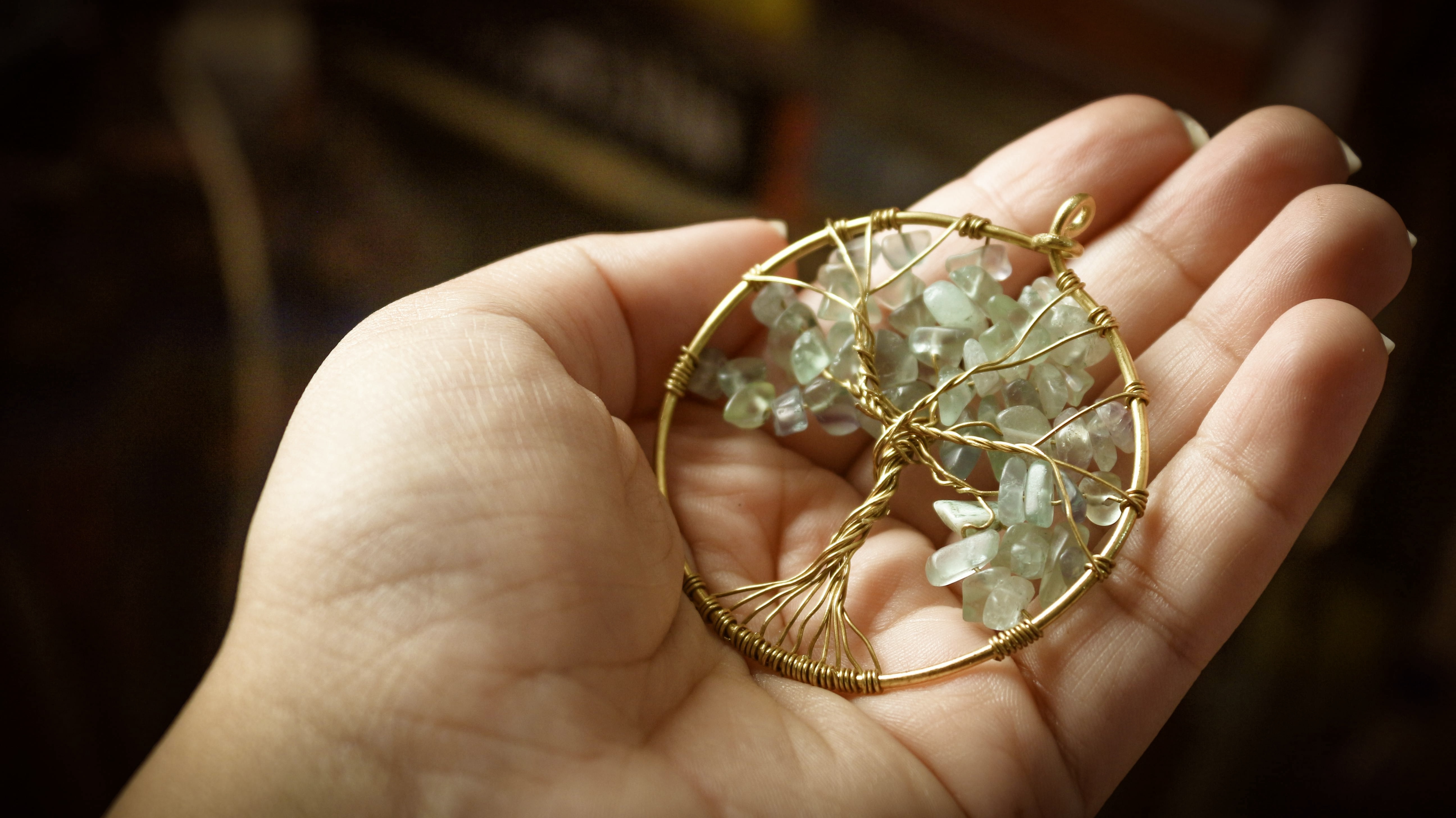
Discover the symbolic power of the Tree of Life for yourself. Humanist Beauty brings the healing energy of crystals to you in the form of exquisite Tree of Life Gemstone Necklaces. Select the one that calls to you, or offer it as a meaningful gift it to a loved one.